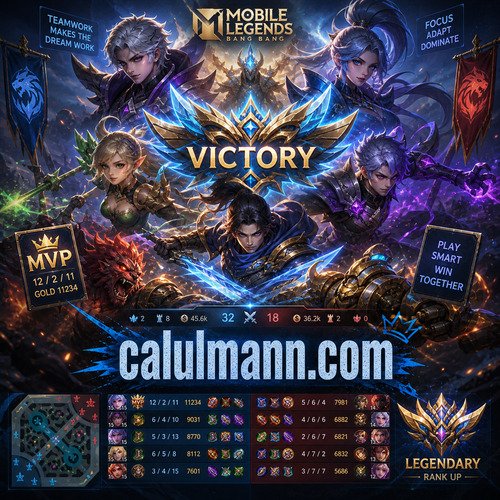
calulmann.com – Mobile Legends: Bang Bang remains one of the most influential mobile multiplayer games because it combines intense action with strategic depth. Every match challenges players to think quickly, coordinate with teammates, and adapt to rapidly changing situations on the battlefield. While some players focus only on mechanics or aggressive gameplay, experienced competitors understand that success in Mobile Legends depends on much more than individual skill alone.
One of the most interesting aspects of the game is how every stage of the match creates different priorities. During the early game, players focus heavily on farming and rotations. The mid game emphasizes objective control and map pressure, while the late game becomes extremely dangerous because one failed team fight can instantly determine victory or defeat. Because of this structure, strong decision-making becomes essential throughout every minute of the match.
Many players struggle to climb ranked mode because they misunderstand what truly creates consistent victories. Kills may create temporary advantages, but objectives, positioning, communication, and teamwork usually determine long-term success. Teams that understand how to control the map and pressure objectives often outperform opponents with stronger individual mechanics.
Improving in Mobile Legends requires patience and continuous learning. Players who analyze mistakes, adapt to new strategies, and maintain discipline under pressure usually become more reliable competitors over time.
Understanding the Core Systems of Mobile Legends
Before mastering advanced strategies, players first need to understand the basic gameplay systems that influence every match.
Every hero in Mobile Legends belongs to a specific role designed to support the team in different ways. Understanding these responsibilities helps players contribute more effectively during objectives and team fights.
Tank heroes serve as frontline protectors. Their responsibilities include absorbing damage, initiating fights, and controlling enemy movement through crowd control abilities. Skilled tank players understand positioning and timing instead of charging recklessly into battles.
Marksmen become highly dangerous during the late game because of their sustained ranged damage. However, they are extremely vulnerable to assassins and crowd control effects. Proper positioning therefore becomes one of the most important skills for marksman players.
Mages specialize in magical burst damage and utility abilities. Mid lane mages frequently influence the pace of the game because they can rotate quickly between lanes and support objectives efficiently.
Assassins rely heavily on mobility and timing to eliminate fragile enemy heroes such as marksmen and mages. Strong assassin players know when to engage and when to retreat instead of forcing unnecessary fights.
Fighters combine offensive pressure with durability, making them effective during side-lane battles and extended team fights.
Support heroes strengthen teammates through healing, shields, buffs, or utility skills. Although support players may not always achieve impressive statistics, their influence on team coordination and survivability is often enormous.
Balanced team compositions generally provide stronger flexibility and survivability compared to teams filled entirely with damage-focused heroes.
Farming and Economic Control
Gold and experience directly determine hero strength throughout the match. Players who farm efficiently complete items faster and become more effective during objectives and engagements.
Minion waves provide reliable gold income and should not be ignored carelessly. Missing too many waves delays item progression and weakens combat potential significantly.
Jungle camps provide additional resources, especially for junglers who need efficient rotations to maintain pressure across the map.
Economic management also involves avoiding unnecessary deaths. Every elimination gives enemies additional gold while temporarily removing pressure from the defeated side.
Understanding item timing is equally important. Certain heroes become dramatically stronger after completing specific core items. Skilled players recognize these power spikes and adjust their aggression accordingly.
Cooldowns and battle spells are also valuable resources. Entering fights without ultimate abilities or mobility spells frequently creates avoidable disadvantages.
Building Strong Map Awareness
Map awareness is one of the most valuable skills in Mobile Legends because it influences nearly every decision during the game.
Players who constantly monitor the minimap can predict enemy rotations, avoid ambushes, and identify opportunities for objectives or counterattacks. Many avoidable deaths happen because players continue pushing lanes aggressively without information about missing enemies.
Rotations are heavily connected to minimap awareness. Mid lane heroes and roamers frequently move between lanes to support teammates and pressure objectives.
Vision control around Turtle and Lord becomes especially important during the mid and late game. Teams that establish positioning before objective fights usually gain major advantages.
Experienced players also begin predicting enemy behavior based on jungle routes, lane pressure, and previous movement patterns. This predictive awareness creates smarter gameplay decisions.
Advanced Strategies for Ranked Matches
Once players become comfortable with the fundamentals, they can improve further by focusing on advanced strategic concepts that influence competitive gameplay.
One of the biggest differences between inexperienced and skilled players is objective prioritization. Many beginners focus too heavily on kills while ignoring towers, Turtle, and Lord.
Destroying towers creates permanent map pressure and expands safe movement opportunities across the battlefield.
The Turtle objective provides valuable gold and experience advantages during the early game. Teams that consistently secure Turtle often gain enough momentum to dominate the mid game.
Lord becomes the most influential neutral objective during the late game because it creates strong lane pressure and forces enemies into defensive situations.
Macro gameplay refers to large-scale strategic decisions involving lane pressure, rotations, and map control. Skilled teams understand when to split-push, when to group together, and when to pressure multiple areas simultaneously.
Strong macro play forces enemies into difficult situations where defending one objective may expose another area elsewhere on the map.
Team Fight Coordination and Positioning
Team fights often determine the outcome of ranked matches because they strongly influence momentum and objective control.
Positioning is critical for every role. Marksmen and mages should remain protected while dealing damage safely from the backline. Tanks and fighters must create space and disrupt enemy formations effectively.
Initiation timing strongly affects whether fights succeed or fail. Engaging too early may isolate teammates, while hesitating too long allows enemies to reposition safely.
Crowd control coordination is another major factor. Teams that combine stuns, knock-ups, and slows effectively can prevent enemies from reacting during critical moments.
Target prioritization also influences fight outcomes significantly. Eliminating enemy carries quickly usually creates much larger advantages than attacking frontline tanks endlessly.
Disengaging properly is equally important. Sometimes retreating safely preserves resources and prevents catastrophic objective losses later.
Drafting and Counter Picking
The drafting phase shapes the match before gameplay even begins. Strong drafts create balanced compositions with effective synergy between heroes.
Counter-picking allows teams to exploit weaknesses in enemy compositions. Certain heroes naturally perform better against specific opponents because of mobility, burst damage, or crowd control interactions.
Flexibility during drafting improves adaptability significantly. Players who can perform effectively with multiple heroes contribute more to overall team strategy.
Communication during hero selection helps establish lane assignments, jungle priorities, and overall game plans before entering the battlefield.
Understanding the current meta also improves drafting decisions because patches frequently influence hero effectiveness and strategy.
Long-term improvement depends not only on mechanics but also on emotional discipline and learning habits.
Staying Calm During Difficult Matches
Ranked matches can become stressful, especially during losing streaks or close late-game battles. Emotional reactions often lead to poor decisions and unnecessary mistakes.
Players who remain calm generally maintain better awareness, positioning, and communication during difficult situations. Instead of focusing entirely on teammate mistakes, strong competitors continue searching for opportunities to recover.
Patience becomes especially important during comeback situations. Many seemingly unwinnable games can still be reversed through smart defense and enemy overconfidence.
Avoiding toxic communication also improves morale and coordination significantly.
Learning Through Replay Analysis
Watching replays helps players identify mistakes involving rotations, positioning, cooldown management, and objective timing.
Self-analysis accelerates improvement because repeated weaknesses become easier to recognize. Players who honestly evaluate their gameplay usually improve faster than those who constantly blame teammates.
Watching professional tournaments and high-level gameplay can also provide valuable insights into advanced macro strategies and drafting patterns.
Adapting to Meta Changes
Mobile Legends evolves constantly through hero adjustments, balance patches, and new strategies. Heroes that dominate one season may become weaker after future updates.
Successful players remain flexible and willing to adapt instead of relying entirely on outdated habits.
Understanding current meta trends helps players recognize which heroes and strategies perform most effectively. However, strong fundamentals remain valuable regardless of balance changes.
Conclusion Mobile Legends Gameplay Mastery: Improving Mechanics, Team Strategy, and Ranked Performance
Mobile Legends: Bang Bang continues to attract millions of players because it combines intense action with deep strategic gameplay. Every role, objective, and rotation contributes to the outcome of the match, making teamwork and awareness essential for victory.
Players who want to improve consistently must focus on more than flashy mechanics or high kill counts. Farming efficiency, objective control, communication, positioning, drafting strategy, and emotional discipline all play major roles in long-term success.
The process of becoming a stronger Mobile Legends player requires patience, adaptability, and continuous learning. Every match offers opportunities to improve mechanics, refine decision-making, and develop stronger teamwork. Through dedication and practice, players can gradually master the complexity of Mobile Legends and fully enjoy the competitive experience that has made the game popular worldwide.
